
Yes, you can almost always sell a house after a death occurred there, and in most states you aren’t even legally required to tell the buyer. But the belongings inside that house are a whole different story, with real legal rules about who gets to decide what happens to them. We know that’s a lot to process on top of everything else you’re dealing with, so we put together this guide to walk you through the property and belongings decisions that come right alongside the cleanup itself.
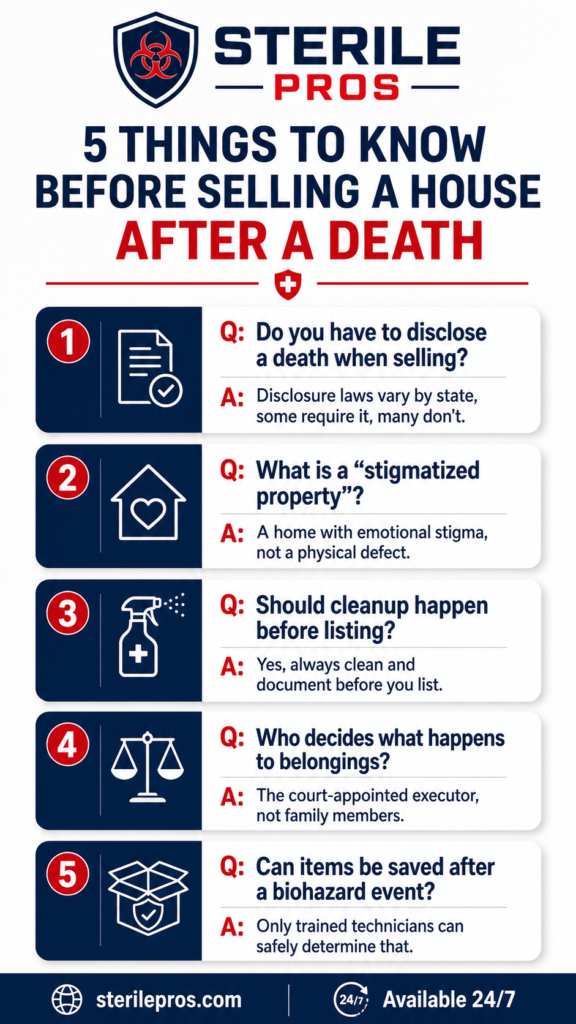
Do you have to disclose a death when selling the house
There’s no federal law requiring you to disclose a death in a home, since every disclosure rule gets set at the state level. According to the National Association of Realtors, most states don’t legally treat a death as a physical defect, which means sellers generally aren’t required to bring it up on their own. California is one of the clearer exceptions here, requiring disclosure if an occupant died in the home within the past three years. Some states only require disclosure if the death happened because of a defective condition in the home itself, like a gas or carbon monoxide leak, rather than the death alone being the trigger. Pennsylvania and Florida both skip a proactive disclosure requirement entirely, though sellers in those states still have to answer honestly if a buyer asks directly. That last part is worth paying attention to. Lying to a buyer who asks a direct question can create real legal liability, even in a state where volunteering the information was never required in the first place. If you want to see how this plays out state by state, this breakdown of stigmatized property laws is a good place to check your own state’s rules.
What counts as a “stigmatized property,” legally speaking
A stigmatized property is a home that carries an emotional or psychological stigma, like a past death, crime, or rumored haunting, rather than an actual physical defect. Most states don’t automatically treat that stigma as a “material fact” the way they would a cracked foundation or faulty wiring. Many states also don’t require disclosure of stigmatizing events that happened nearby, only what happened inside the home itself. Violent deaths tend to carry a stronger negative impact on buyer perception and resale value than natural or peaceful deaths, even in states with no legal disclosure requirement at all. None of that changes whether the cleanup needs to happen professionally and thoroughly, which we cover in more detail on our page about who pays for crime scene cleanup.
Does cleanup need to happen before you list the property
Cleanup should always happen before you list the property, honestly, before you do much of anything else. A property that hasn’t been professionally remediated can carry lingering odor, staining, or biohazard risk that shows up the moment a buyer’s inspector walks through, and that’s the kind of thing that kills a sale fast. Keeping documentation from your cleanup, things like the completion certificate, before-and-after photos, and waste disposal records, gives you something solid to show a buyer or agent if questions come up later. That paperwork matters even more if your homeowners insurance covered part of the cost, since an unresolved claim can slow down closing. Our insurance claims page walks through exactly what that documentation should look like and how to stay organized through it.
Who legally decides what happens to a deceased person’s belongings
If the estate is going through probate, only the executor or personal representative formally appointed by the court has legal authority to handle the deceased person’s belongings. That authority isn’t just a formality either. An executor holds a fiduciary duty, meaning every decision about estate property has to serve the interest of beneficiaries and creditors, not personal preference, according to Justia’s overview of executor responsibilities. That responsibility specifically covers locating, securing, and protecting personal belongings, not just financial assets or the property itself. In Texas, for example, the Texas State Law Library confirms an executor is legally required to protect the deceased person’s property until debts and taxes are settled, and only then does whatever remains legally pass to the rightful heirs. None of that authority is there so someone can take or use those items for themselves. It’s there to protect them until the legal process sorts out where they belong.
What items can typically be kept versus what has to be discarded
Sentimental or valuable items that weren’t affected by contamination can usually be cleaned, documented, and returned to family, but that really depends on what part of the home was impacted and how. Items that came into direct contact with biohazard material generally can’t be saved, since porous materials like fabric, upholstery, and paper absorb contamination in ways that can’t be undone through cleaning alone. That’s exactly why this decision needs to come from trained biohazard technicians, not family members standing in the room trying to make an impossible call in the moment. Our team handles that separation carefully on every single job, documenting what’s being removed and working directly with families or the estate’s executor so nothing gets discarded without agreement first.
What happens if there’s no will or next of kin hasn’t been established yet
When there’s no will and no confirmed next of kin, belongings and property typically fall under your state’s intestate succession law until an heir gets legally identified. If an inheritance goes unclaimed long enough, it usually gets transferred to a state unclaimed property agency, which holds those assets until the rightful heir comes forward, as explained by Western & Southern’s guide to unclaimed inheritance. State unclaimed property programs return billions of dollars in unclaimed assets to rightful owners every single year, which tells you this situation happens a lot more often than most families realize. That process can take time, and that’s exactly why professional cleanup and secure handling of belongings matters in the meantime. A property left unmanaged during that legal limbo is vulnerable to damage, theft, or just quietly falling apart while everyone waits.
Can family members remove items themselves before a cleanup crew arrives
We get why the instinct is there, but family members generally shouldn’t remove items from an affected area before a professional crew arrives. Areas affected by a death or crime can carry contamination risks that aren’t visible to the eye, and removing items yourself can also interfere with the executor’s legal responsibility to properly account for estate property. The safest move is to let us assess the space first, figure out what’s salvageable, and coordinate directly with you or the estate representative on how those items get handled from there. You can find answers to the questions families ask most before that first call on our FAQ page.
How Sterile Pros handles belongings during a real job
Every job starts with a full assessment before anything gets touched, cleaned, or removed. Our technicians document affected areas and separate what’s salvageable from what has to be treated as biohazard waste under state disposal requirements. We stay in direct contact with families, executors, and property managers throughout that process, so nobody’s left wondering what happened to something that mattered to them. That same care carries over to the property itself, since a properly documented cleanup gives you exactly what you need whether you’re moving back in or getting ready to list the house.
If you’re facing this decision right now, you don’t have to sort it out alone. Give Sterile Pros a call, and we’ll walk you through what comes next, from the cleanup itself to the paperwork you’ll want in hand before you make any decisions about the property or what’s inside it.