
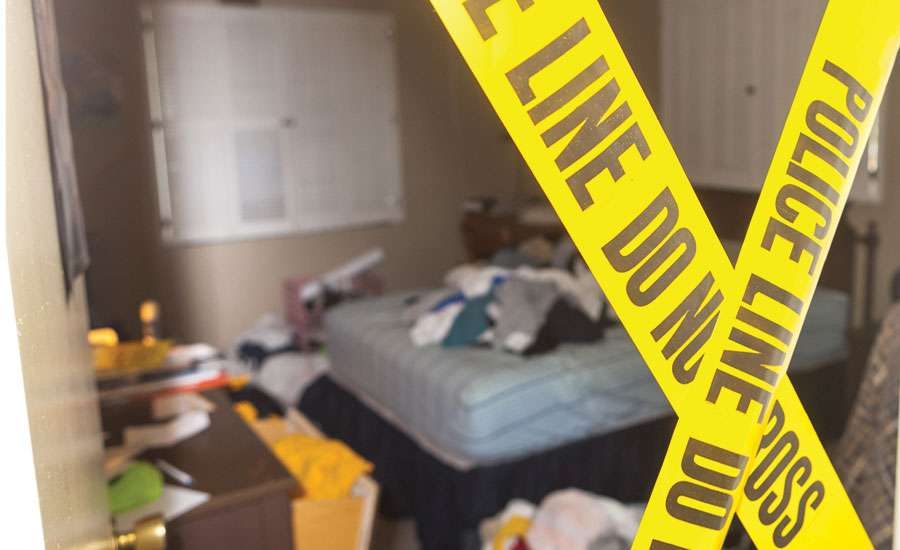
CSI wraps up a crime scene in under an hour. Real crime scene cleanup takes days, follows strict state law, and carries risks no TV writer ever mentions. Sterile Pros handles the real version of this work every day across California, Nevada, Arizona, and Texas, and we want to walk you through exactly where the show ends and the actual job begins.
True crime shows, forensic dramas, and games like Crime Scene Cleaner have made this profession feel familiar to millions of people who have never actually needed the service. That familiarity creates a real problem. People walk into their first cleanup call with expectations built entirely on fiction, and that gap can cost them time, money, or worse, their safety. Below are the myths TV sells hardest, matched against what actually happens on a real scene.
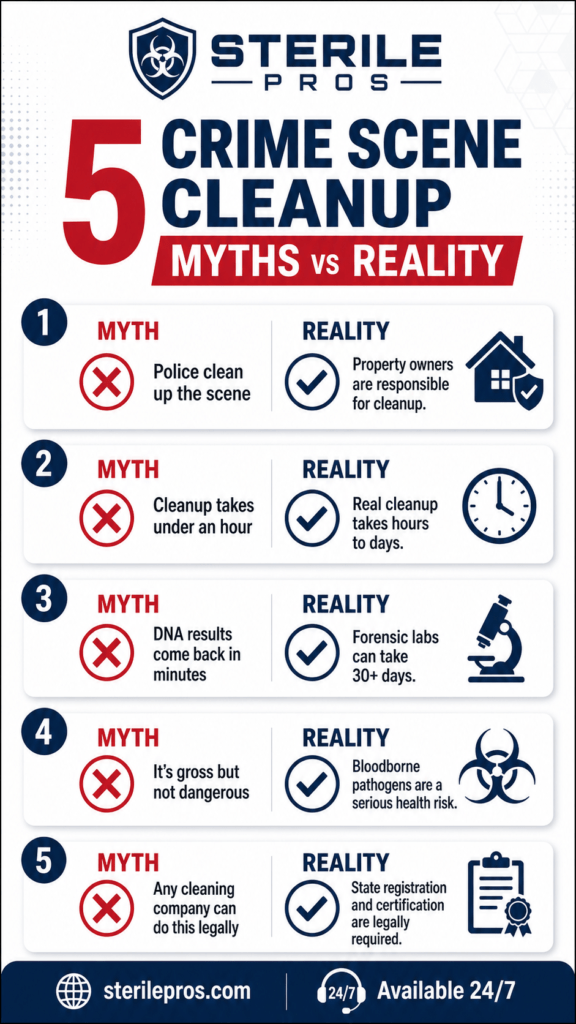
Myth: Police or the coroner clean up the scene
Police and coroners never touch the cleanup. Their job ends the moment evidence is collected and the property is legally released back to the owner. From there, responsibility shifts entirely to whoever owns or controls that property, whether that’s a homeowner, a landlord, or a business owner. We break this down in detail on our page about who pays for crime scene cleanup, and it’s usually the first thing people learn the hard way, standing in a doorway with no idea who to call next. That’s exactly the moment Sterile Pros steps in.
Myth: The whole thing wraps up in an hour, just like the episode
Real cleanup takes hours to days, not the 45 minutes a TV episode allows. Contamination works its way into flooring, drywall, and furniture in ways that require careful removal, not a quick wipe-down. Our breakdown on crime scene cleanup costs shows why timelines and pricing shift depending on how severe the scene is. A straightforward job might close out same-day. One involving decomposition or structural damage can take a lot longer, and that’s just the honest truth of it.
Myth: DNA results come back before the credits roll
DNA results never come back in minutes, no matter what the show implies. The National Institute of Justice officially considers a forensic DNA case “backlogged” if it isn’t completed within 30 days of reaching the lab, which tells you just how far real life sits from TV pacing. Even with faster lab techniques cutting processing time from months down to days, many labs still can’t keep up with the volume coming in. Real forensic science answers to evidence chains and court standards, not a 42-minute runtime.
Myth: Crime scene cleaners help solve the case
Cleaners and investigators do completely separate jobs, with zero overlap between them. Investigators collect and analyze evidence. Cleaners only step in after that process wraps and the scene has been officially released. Mixing up these two roles is one of the most common misunderstandings people carry into their first call, and it’s worth clearing up before you ever pick up the phone.
Myth: It’s a gross job, but not actually dangerous
Bloodborne pathogen exposure is a real, documented health risk, not a scare tactic. The CDC estimates more than 5.6 million U.S. workers face occupational exposure risk to pathogens like hepatitis B, hepatitis C, and HIV every year. Research shows hepatitis B alone transmits at a rate of 6 to 30 percent following occupational exposure, compared to 1.8 percent for hepatitis C and 0.3 percent for HIV. About 3 million bloodborne pathogen exposure incidents happen annually in the U.S., including 400,000 sharps injuries in hospitals alone. That’s exactly why OSHA’s Bloodborne Pathogens Standard legally applies to anyone with reasonably anticipated contact with blood or other potentially infectious material, which includes every technician on a Sterile Pros crew. If you’re weighing whether to handle something yourself, our page on whether DIY crime scene cleanup is safe or legal lays out exactly why that’s a risk not worth taking.
Myth: Anyone with cleaning supplies can legally do this job
Regular cleaning companies cannot legally perform trauma scene cleanup in California without state registration. The California Trauma Scene Waste Management Act, passed back in 1998, requires anyone doing this work for pay to register with the California Department of Public Health. Registered practitioners also have to maintain a documented relationship with a registered medical waste transporter or permitted disposal facility. Sterile Pros holds this exact registration, which you can read more about on our California biohazard cleanup laws page, and you can verify any company’s status directly through the CDPH’s public registry in about two minutes. That quick check is one of the easiest ways to protect yourself from hiring someone operating outside the law.
Myth: The cleaners walk away unaffected once the job is done
The emotional weight of this work is real, not exaggerated for drama. More than 80 percent of first responders experience a traumatic event on the job. Roughly 1 in 3 develops PTSD over the course of a career, compared to roughly 1 in 5 in the general population. Broken down by role, research shows PTSD affecting 15 percent of paramedics, 13 percent of rescue teams, 7 percent of firefighters, and 5 percent of police officers. Crime scene cleaners sit right in that same high-exposure category, and the calm, steady approach our technicians bring to a scene comes from real training and real experience, not indifference.
What actually happens when Sterile Pros gets the call
A real cleanup starts with a phone call, not a dramatic entrance. Our team assesses the scene, checks on insurance coverage where it applies, and begins containment before any visible cleaning even starts. You can find more on how that insurance piece works on our insurance claims page, since most people don’t realize how much of the cost can be covered. Every technician follows OSHA bloodborne pathogen protocols and CDPH-registered disposal procedures on every single job, no exceptions. The goal is a property that tests clean and a family or property owner who never has to see the aftermath firsthand. It isn’t glamorous, and it isn’t fast, but it’s handled by people who take the legal, medical, and emotional weight of this work seriously.
If you’re dealing with a real situation right now, skip the research rabbit hole and call us directly. Our FAQ page answers the questions people ask most before that first call, and Sterile Pros is available 24/7 to show up in person, not just on a screen.